We build the software your business runs on, and we keep it running.

Most companies build your system and hand it over, leaving you to manage the upkeep and own the failures. We build it and stay responsible for the result. You get one accountable partner and software you can depend on.

What we build for

Financial services and paymentsCommerce and marketplacesCommunications and messagingLogistics and distributionHealthcareHospitalityManufacturing and distributionFinancial services and paymentsCommerce and marketplacesCommunications and messagingLogistics and distributionHealthcareHospitalityManufacturing and distribution

Built for work that has to be done properly.

Some businesses come to us with no technical team. Others have a good one that is already at capacity. Both need the same thing: senior people who can take a system from idea to live, and carry the responsibility for it afterwards.

If the software matters to how your business runs, it is the kind of work we take.

The problem

Building software is the easy part. Keeping it working is not.

Every vendor will tell you they can build it. Fewer will tell you what happens in year two. Most businesses can get something built. The harder job is the one that never ends: keeping it working as it meets real users, real load, and providers that change without notice. That is the job most companies walk away from.

The market gap

Most vendors are one or the other.

You have met the ones who build fast and disappear, and the ones who advise well and never touch the code. Both leave the same gap: nobody stays accountable once it is live.

Builds the system

Freelancer or agency

Yes

Consultant or advisor

No, advises only

Embary

Yes

Stays after launch

Freelancer or agency

Rarely, the contract ends at handover

Consultant or advisor

No, the engagement ends at the report

Embary

Yes, that is the default way we work

Accountable when something breaks

Freelancer or agency

Depends who you can still reach

Consultant or advisor

Not their job to begin with

Embary

Yes, with a published response time

Who you deal with

Freelancer or agency

Whoever is available that week

Consultant or advisor

A senior partner, until the report ships

Embary

The same accountable team, named up front

How we work with you

Three engagement models.

Pick the shape of the relationship, not just the price. One team stands behind all three.

Primary path

Managed operations

We build the system and we run it.

Hosting, monitoring, updates, and accountability when something goes wrong. A build fee, then a monthly operating agreement. Most of our clients work with us this way, and it is what the company is built around.

Project build

Fixed scope, delivered and handed over.

We build the system, get it live, and hand it to your team with the accounts, documentation, and knowledge they need to run it. For businesses with their own engineers who need capacity rather than cover. No ongoing commitment, and the door stays open if you want us back.

Advisory

Judgment without hands.

Architecture review, compliance and regulatory assessment, or a second opinion on a build already underway. For teams who need to know whether the plan holds before they commit to it.

Not sure which fits? Describe the situation and we will tell you plainly what we would recommend, including if that is none of the three.

What we build

We build across sectors deliberately. Every system we build teaches us the providers, records, and rails a sector runs on, and that knowledge compounds into the next build.

Wallets, transfers, collections, disbursements, and balances that have to reconcile to the naira. These systems talk to banks, card processors, settlement rails, and identity verification, and they answer to the CBN and the NDPA.

The hard part

The hard part is never the interface. It is what happens to a transaction that half succeeded, and whether your records survive an audit. We operate a live wallet and marketplace today, including tokenised transfer, zero-fee internal payments, and bill payment.

Storefronts, listings, order management, inventory, and settlement between parties who have no reason to trust each other. Connects to payment gateways, logistics providers, and the social channels orders actually arrive through.

The hard part

The hard part is orders landing from four places at once, stock that has to stay accurate across all of them, and splitting money correctly between sellers when something is returned.

Business messaging at scale: enquiries, notifications, order confirmations, and follow-up. Connects to WhatsApp Business accounts, messaging providers, and the customer records behind them.

The hard part

The hard part is that messaging providers change their rules and their pricing without asking, and a business whose operations live in a chat thread has no record of what was promised to whom. We have built an operating layer over business WhatsApp that turns conversations into structured orders.

Dispatch, assignment, tracking, proof of delivery, and driver-facing applications. Connects to mapping and routing, messaging, payment on delivery, and the warehouse or inventory system behind it.

The hard part

The hard part is that the field is not the office. Applications have to keep working on a bad connection and reconcile later, and cash collected on delivery has to end up matching the ledger.

Patient records, appointments, billing, claims, results, and pharmacy stock. Connects to HMO and insurance claims processing, laboratory systems, and pharmacy inventory.

The hard part

The hard part is that this data is the most regulated category you can hold under the NDPA, downtime has consequences beyond revenue, and claims reconciliation with HMOs is where most clinics quietly lose money.

Bookings, front desk, point of sale, guest records, and rate and availability management. Connects to booking channels and travel agents, payment terminals, and property management systems.

The hard part

The hard part is selling the same room twice. Availability has to stay consistent across every channel in near real time, and a channel that fails silently costs you either revenue or a very bad arrival.

Production tracking, inventory across locations, order capture, and distributor networks. Connects to accounting and ERP systems, warehouse management, and the payment and credit terms underneath a distributor relationship.

The hard part

The hard part is that stock is never in one place, distributors sit in a hierarchy with different pricing and credit, and the numbers in the system stop matching the numbers in the warehouse the moment anyone works around it.

What we've built

Commerce ยท in build

MessageBench

Many Nigerian businesses run on WhatsApp: orders, payments, and delivery updates, all in the chat. MessageBench sits on top of that and keeps it organised. It sorts enquiries, turns chats into orders, tracks deliveries, and follows up with customers. Built in house. Not yet live.
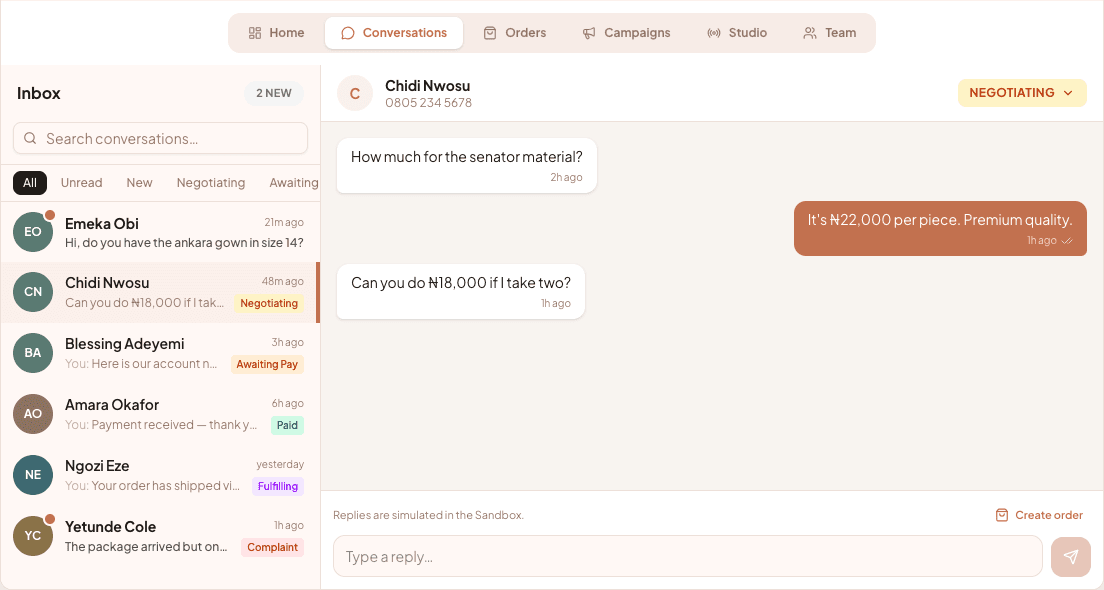
The MessageBench inbox, showing a WhatsApp order negotiation being tracked through to a created order

And more

Professional services

Document automation

A law firm's tax practice receives its files by email, from clients, from counsel, from the revenue authority itself, with no consistent structure or naming. We built an automation that reads what comes in, works out what each attachment actually is, and routes it to the right matter, so nothing that matters sits unsorted while a deadline gets closer.

Events

Event management app

Events run on timing: who is confirmed, what happens when, and who needs to know right now, not in a recap email sent the next day. We built a mobile app for a client running live events so that information moves in real time instead of living in a spreadsheet someone has to keep re-checking.

Marketing

Bartertrybe

Bartertrybe is a marketing hub we built to run our own outreach and campaigns without stitching together half a dozen separate tools. It works well enough that it is now part of how we operate day to day, not just something we built and moved on from.

Retail and logistics

Abuja Outpost

Abuja Outpost is a warehouse and inventory system built for a client. The hard part in this kind of system is never the interface, it is keeping what the software says is on the shelf matching what is actually there, especially once stock is moving faster than anyone could track it by hand.

How we build

We build for the version that has to last.

Anyone can ship something that works in a demo. We build for the version that keeps running under real load, for years, including the failure paths most teams only discover in production. That discipline is the difference between software that impresses once and software you can run a business on.

  • We design for the load you will have, not the load you have now. The architecture decisions made in week one are the expensive ones to reverse.
  • We tell you what you have not asked about. Compliance exposure, regulatory requirements, security gaps, and the places a system is likely to strain. You hear about them from us before they become your problem.
  • Nothing significant gets built without you seeing it first.

Our process

How a project runs.

01

Discovery

We work out what you are actually trying to achieve, which is often not the thing described in the first meeting. What the business needs, who uses it, what it has to connect to, and what success looks like in numbers.

02

Research and compliance

Whether the idea holds up in the real world, and what regulation touches it. Data protection, financial licensing, provider requirements, and anything else that governs what you are allowed to build. Most builds discover this late. We do it before anything is designed.

03

Prototype

A clickable prototype of the real thing. You see how it works, how it feels to use, and what leads to what, before a line of production code is written. Changes here cost hours. The same changes after build cost weeks.

04

Build

Development with a scheduled check-in every week or two, so you always know what has been done, what is next, and what has moved. No silence between kickoff and delivery.

05

Readiness

App store submission and review, third party accounts and approvals, dependency and provider setup, and the unglamorous work that decides whether launch day is calm. This step is where most projects lose their timeline, so we plan it rather than discover it.

06

Launch or handover

For clients we operate for, we launch and the monthly agreement begins. For build and hand over clients, we hand across the system, the accounts, and the documentation your team needs to run it, and we stay reachable while they settle in.

Working together

You should never have to ask how it is going.

Most software work goes quiet once the contract is signed. You find out where things stand by chasing someone, and you hear about problems last. We run the opposite way round.

Updates arrive on a schedule, not on request.

Through the build you get a written update every week or two: what was completed, what is next, and anything that has slipped and why. You do not have to ask, and you do not wait for a milestone to know where you stand.

We sit down with you twice a month.

In person, a real review of where the system is, what we would change, and what is coming. Not a status email.

Everything agreed is written down.

Scope, approvals, decisions, and paperwork live in one place, so neither of us is relying on memory about what was agreed six months ago. That record protects you more than it protects us.

You choose how the day to day runs.

You name the channel your team already uses and the people who speak for the project. We name ours, including the engineer who handles support directly.

What we commit to

We watch it constantly. Automated monitoring runs day and night: whether the system is up, whether it is performing, and whether the services it depends on are healthy, with alerts reaching us the moment anything moves out of range. A problem reaches us before it reaches your customers.

Critical

The system is down, or money is not moving

Response

Within 1 hour

Major

An important function is broken, system still usable

Response

Within 4 hours

Minor

A small bug or request, a workaround exists

Response

1 to 2 business days

Monitoring always on.

We are honest about what we do not control. When an outage sits with a third party such as your bank or a messaging provider, we manage it on your behalf and keep you informed, even though the fix is not ours to make.

Applies to build and operate clients.

How we operate in full

Why we exist

Excellence is the difference between software that works and software a business can rely on.

Most business software here is either bought from abroad and bent to fit, or built once and left to age. Both leave the business carrying a system nobody is answerable for.

We build systems that fit how a business actually runs, and we operate them to a standard we publish and can be held to.

Excellence is the standard, not the pitch.

We are measured by what happens after launch.

We claim only what we can prove.

Every system we build sharpens the next one.

Start a conversation.

Tell us what you are building, or what is failing. If we are the right fit, we will show you how we would approach it. If we are not, we will say so.